Most SaaS companies treat YouTube as a dumping ground for product demos and webinars. The thought and care that go into email newsletters and executive LinkedIn programs rarely extend to YouTube channels.
But video has become a go-to format for product research. So, where does YouTube fit into the mix?
We analyzed 3,623 videos across 71 B2B SaaS YouTube channels to find out.
Paid promotion accounts for 91.4% of all long-form views
Many of the most-viewed B2B SaaS YouTube videos are promoted through YouTube Ads rather than generated organically.
They're easy to spot: extreme view counts paired with engagement rates an order of magnitude below organic baselines.

We applied a conservative filter to separate the two. Any video with ≥50,000 views AND an engagement rate below 0.0005 was flagged as “paid-promoted” and excluded from organic performance analysis.
The threshold catches videos where engagement is so disproportionate to their reach that paid distribution is the only realistic explanation.
For the rest of this study, every claim about "what works" is computed against the organic distribution only.
YouTube videos appear in AIOs for 74.9% of SaaS keywords and queries
Of the 873 searches we ran, 95.4% triggered an AI Overview (AIO).
74.9% (624 of 873) cited a YouTube channel, and only 4.2% cited a tracked SaaS channel.
Across 542 BOFU keywords (e.g. "best CRM software," "klaviyo alternatives," and "hubspot vs salesforce"), YouTube appeared in the AIOs 75.1% of the time.
Of those BOFU terms, our tracked brands only appeared 3% of the time.
Finally, of 138 branded keywords in our dataset (e.g. "hubspot vs salesforce", "klaviyo alternatives", "monday.com vs asana"), YouTube was cited in the AIOs for 120 of them (87%).
However, 0.7% of those citations came from any of the 71 brand channels we tracked.

Independent creators dominate the rest. The top 10 cited channels in our dataset are HelperMan, Consumer Research Studios, Merchant Maverick, and 6 other independent creators.
61 of the 71 brand channels we studied earned zero AIO citations across the entire 873-query study. Among the 10 brands that did appear, 9 earned five or fewer citations.
Only ClickUp earned more than nine citations across more than four keywords:

This doesn’t mean that AIOs aren’t prioritizing brand channels. One likely explanation is that our tracked brands are producing less content aligned with buyer queries and prompts. We see this is the case with ClickUp (and through our own experiences with clients at Grizzle).

Top 10% of videos drive 42.2% of channel views
The top 5% of videos account for a median of 25.1% of total channel views. The top 10% accounts for 42.2%.

This isn't a SaaS quirk; it's how YouTube content is generally distributed.
A handful of videos in any given channel earn most of the attention. The rest accumulate views slowly or not at all.
This is true whether the channel publishes 30 videos a year or 300.
It would be easy to conclude that we should produce fewer, higher-quality videos. However, higher publishing velocity is correlated with breakout formats.
Most channels publish their lowest-performing videos on a set cadence (e.g., webinars, feature releases).
Video formats that generate views are rarely replicated, even when they outperform newer videos.
These findings share a best practice that most B2B SaaS teams skip: figure out which of your videos drive views, study what they have in common, and standardize them.
Winning formats aren't predictable. You need enough at-bats to find them. The top-performing channels showed a pattern consistent with analyzing top performers and doubling down on winning formats.
YouTube title patterns that earn views (and the ones that hurt)
We analyzed every word, structure, and convention across our 1,954 organic long-form videos and measured each against the 218-view organic baseline.
Eight patterns are associated with performance meaningfully above baseline.
Titles that perform above baseline
Dollar amounts in the title earn 10x the baseline. Titles like "How I Built a $5M SaaS in 18 Months" or "We Spent $50K on This Campaign and Here's What We Learned" pull the strongest median views in the entire dataset.
The number itself functions as a specificity signal, telling viewers there's a concrete outcome on the other side of the click.
First-person voice earns nearly 5x. Titles like "I Tested Every CRM" and "My Worst Hire Cost Me $200K" outperform the baseline by 4.90x.
This is the same first-person voice that dominates the AIOs (8.4% of cited videos use it, vs 2.1% in branded B2B channels). "I," "my," or "I've" signal real-world perspectives.
"Best" in the title earns 3.24x. Listicles and category roundups continue to perform exactly as you'd expect from the cited-universe data.
Titles like “The 5 Best Project Management Tools" and "Best CRM for Small Business" win both attention and AIO citations for BOFU terms.
Brackets and parentheses earn 2.98x. Titles with [2026 Update] or (Step-by-Step) or [Free Template] clarify what the viewer is getting before they click.
The bracket is, functionally, a UI element that visually separates a tangible promise from the topic itself.
The other winners all share a common structural property: they tell the viewer specifically what they'll get by watching.
Underperforming title patterns
The underperformers are remarkably consistent and common in B2B SaaS YouTube channels.
Dash-separated titles earn 0.44x baseline. "Brand Name - Product Demo - Q3 Webinar" is the canonical format here.
The dashes signal cataloging, implying that the video was uploaded for internal organization, rather than to add value.
Titles with the word "podcast" earn 0.63x. This is one of the most counterintuitive findings in the dataset. Branded B2B podcasts on YouTube consistently underperform the channel's other content.
This doesn’t mean that podcasts aren’t effective; they’re just usually packaged in a way that doesn’t signal the value a user will get from watching or listening.
Titles 70+ characters earn 0.75x. Long titles are truncated. They're often the result of a marketing team trying to keyword stuff rather than communicate value. Both are important.
The remaining underperformers share the same structural property: they describe what the video is rather than promising what the viewer will get.
Most B2B YouTube titles include underperforming patterns
38% of SaaS video titles use only underperforming title patterns. Only 18% use winning patterns.
Underperforming title patterns show a median of 160 views; those using only winning patterns show 734.

Combining winning and underperforming patterns showed no meaningful lift over using neither. 16% of videos that contain both earn a median of 212 views; essentially the same as titles using neither.
Adding "Best" to a title that still leads with a brand name doesn't lead to any meaningful lift.
An important note: some of these conventions show up in the AIOs at meaningful rates. A title like "HubSpot - Product Demo" performs worse than "ClickUp vs Notion - Which Is Better?"
63% of B2B SaaS thumbnails use the worst-performing aesthetic style
Three aesthetic thumbnail styles dominate the dataset:
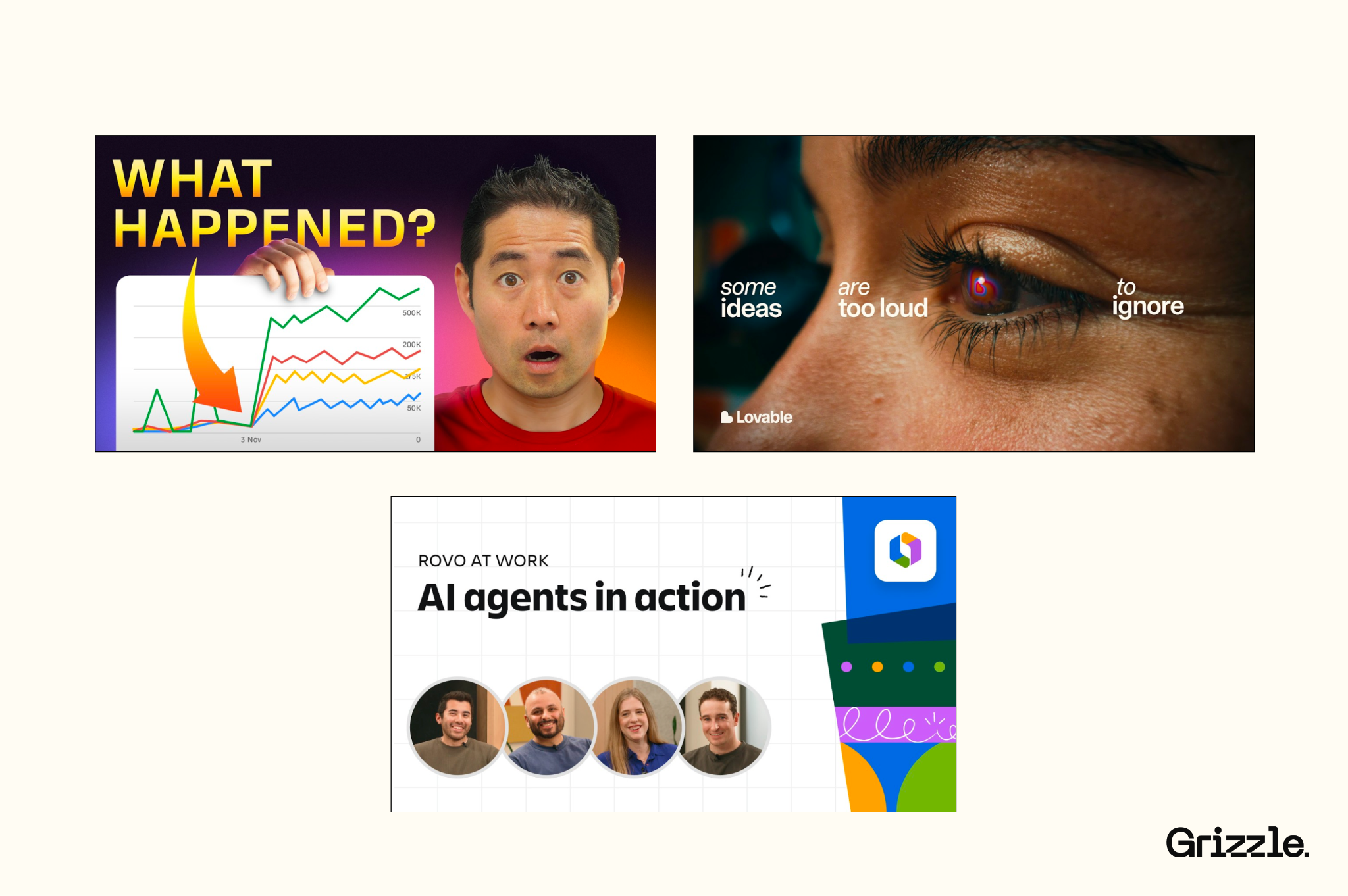
- Corporate/clean. Neutral colors, restrained typography, plenty of white space. The default B2B SaaS look.
- Editorial/magazine. More design-forward, often with overlaid pull quotes or magazine-style layout.
- Creator-style. Bright contrast colors, expressive faces, bold sans-serif text, deliberate visual chaos.

Creator-style thumbnails make up just 16% of the dataset but earn a median of 582 views (2.67x above the organic baseline).
Corporate-style thumbnails make up 63% of the dataset and earn 171 views, well below baseline.
The most common choice in B2B SaaS is also the lowest-performing. The highest performing thumbnails tend to look the least polished and corporate.
Visual complexity is counterintuitive
A common design assumption is that clean, minimal thumbnails beat busy, cluttered ones. Our data suggests the opposite:
- Clean/minimal (27% of dataset): median 176 views (0.81x)
- Moderate (62%): median 204 views (0.94x)
- Busy/cluttered (11%): median 475 views (2.18x)
YouTube thumbnails compete in a feed against creator content. Visual density suggests there's something worth paying attention to and stops the scroll.
Thumbnail patterns that work
Beyond aesthetic style and complexity, three simple binary features predict performance:
- Bright contrasting colors (64% of dataset): 1.93x lift when present
- Face + text + UI elements like icons, annotations, and graphs (rare structural combo, 7%): 2.04x lift
- Face + text overlay (without UI elements) is the most common combo (43%), but only earns a 1.14x lift
The face + text + product UI element combination is the rarest of the three structural configurations, yet it’s the highest-performing:

Most B2B SaaS thumbnails either show a person OR UI elements OR text overlay. The combination earns 2x the baseline.
Owner.com's thumbnails are almost all creator-style (the highest-performing category, scoring 2.94 on the 1-3 aesthetic scale against a 1.53 organic mean). 100% feature a face, 78% use bright contrast color, and 50% include numbers in the visual (against a 21% baseline).
Their long-form videos earn a median of 2,413 views—ranking #9 of 69 channels by median organic views—with zero paid promotion.
Thumbnails aren’t a magic bullet
Thumbnail patterns aren’t deterministic.
One SaaS brand in our dataset scores high on every winning thumbnail dimension: bright contrast color, prominent face presence, high aesthetic style.
However, its median view count is 62, well below the baseline of 218 (0.28x).
Thumbnail patterns may support CTR, but they aren’t sufficient. Topic selection and channel positioning still matter.
Shorts up to 15 seconds long earn 2.72x more views
We analyzed 1,533 organic Shorts across the same 71 channels. The organic baseline for Shorts is 445 views; roughly double the long-form baseline.
Duration is the dominant lever
Duration is the strongest predictor of Shorts performance in our dataset.

Shorts under 15 seconds earn a median 1,210 views (2.72x the baseline). They're the highest-performing duration bucket by a wide margin.
They're also the rarest among our dataset: only 7% of SaaS Shorts fall within this duration.
The modal duration in is 45-60 seconds, with 35% of the dataset falling within this range. These earn a median 233 views (0.52x the baseline).
The most common Shorts are the longest and lowest-performing. 70% of B2B SaaS Shorts are 31 seconds or longer.
Title patterns flip from long-form
Listicle and tutorial framing wins in long-form. In Shorts, the patterns that earn the most views are curiosity hooks:
"Best," year markers, or "X vs Y" comparisons don’t make the list. The patterns that dominate the long-form cited universe are absent from the Shorts winners.
Among our dataset, Lovable is pushing these patterns the hardest. Their 29 organic Shorts earn a median of 187,214 views, the highest in the study.
Their top Short, "How Much Coffee Do Humans Drink?", has earned over 41 million organic views. The titles consistently use the personal "I/my" voice ("I created their dream app", "I Build His Dream Website In 2 min"), curiosity hooks, and questions.
The lowest-performing Shorts title patterns include:
Shorts are consumed in a different context. Titles and descriptions have to stop the scroll, not promise a complete answer.
Description length matters
Most B2B SaaS teams treat Short descriptions as an afterthought. The data suggests length is crucial for performance:
- No description (16% of Shorts): 0.68x baseline
- Short, 1-10 words: 1.74x baseline (the highest-performing length)
- Medium, 11-50 words: 1.09x baseline
- Long, 50+ words: 0.86x baseline
Having a description present outperforms no description by more than 2.5x. 50+ word descriptions underperform the baseline. The optimal description is a single sentence of no more than 10 words.
Format split per channel
Of the 56 channels in our dataset with at least 10 long-form videos and 10 Shorts, the median Shorts:long-form ratio is 1.48x
The typical channel earns 48% more views per Short than per long-form video.
But the distribution is bimodal:
- 17 channels: Shorts earn more than 2x their long-form
- 14 channels: long-form earns more than Shorts
- The remaining 25 are roughly balanced
The channels with a Shorts-dominant strategy have figured out how to make them work. Others are clearly long-form-dominant. Both can work, depending on what outcome you’re prioritizing.
Most SaaS YouTube programs treat them as variations of the same message. The data says they're not. Shorts and long-form videos are different formats with different rules.
The library effect: old videos still earn views
We grouped all 1,954 organic long-form videos into age cohorts based on how long they'd been published as of our pull date, then measured median view velocity (views per day, lifetime) across each cohort:
The decay-then-rebound pattern
Views per day drop sharply through year one—from 8.60/day to 0.68/day—which is what you'd expect as initial attention wears off.
In the 1-2 year cohort, median velocity rebounds to 1.70/day, more than double the 180-365 day cohort.
33% of videos older than 5 years still earn at least 1 view per day. However, this isn’t sustained beyond the 2- to 3-year cohort, which drops to just 11%.
This is consistent with videos earning search and AIO visibility long after publication. By the time a video is a year old, it's either found a steady source of organic discovery or views drop close to zero.
What we can't claim from this data
A single snapshot can't prove that old videos are currently earning ongoing traffic. We have cumulative view counts as of our pull date, but no time-series data.
The rebound in the 1-2 year cohort might reflect ongoing discovery, or it might reflect a small set of unusually strong videos that earned most of their views in their first year and held.
What the data does suggest, even at this confidence level, is that SaaS YouTube libraries are an asset class that most teams systematically underweight.
What this means for SaaS YouTube programs
This study identifies patterns that indicate traditional “creator” YouTube principles are just as effective for SaaS brands.
Channels that break out of that pattern share three traits:
- They make an explicit strategic choice. Are you playing for AI Overview placement, niche category dominance, or top-of-funnel reach? These require different content, different cadences, different production capabilities.
- They study their hits. The top 10% of videos in any channel account for ~42% of its views. The teams that analyze top-performers, identify what makes them effective, and double down on them start to compound.
- They work with the algorithms, not against them. Long-form titles that promise viewer benefit, Shorts produced for the format on its own terms, thumbnails designed to win attention in a feed. Each pattern leans into what each platform mechanic rewards. Stack enough of them, and the algorithm starts working for you, not against you.
Methodology
We pulled video and channel metadata for 71 leading B2B SaaS YouTube channels via the YouTube Data API, featuring both established brands (e.g., HubSpot, Atlassian) and newer entrants (Granola, Lovable).
- The analysis covers 3,623 videos total (1,976 long-form and 1,647 Shorts) across January 2007 through May 2026. For each video, we captured title, description, duration, view count, like count, comment count, published date, engagement rate, and format.
- The pull was capped at the most recent ~30 long-form and ~30 Shorts per channel. For marketing teams asking what's working right now, recent output is a more reliable signal than a decade of uploads. Channels with large back-catalogues are represented by their most recent work.
- We analyzed 873 keywords to capture every YouTube video cited in AIOs, video carousels, and other SERP features. Keywords were split across informational, non-branded bottom-of-funnel (BOFU) queries (e.g. "best CRM software"), and branded terms and comparison queries (e.g. "hubspot vs salesforce").
- For thumbnail analysis, we coded 1,976 thumbnails via the Anthropic API, against a structured taxonomy of binary features (face, text, product UI, etc.) and stylistic dimensions (aesthetic style, complexity, contrast, emotional intensity).
The patterns identified in this study are correlational. We can't confirm that any individual pattern causes higher or lower performance, but the associations are consistent enough across the dataset to be directionally useful.









%20agencies%20for%20B2B.png)